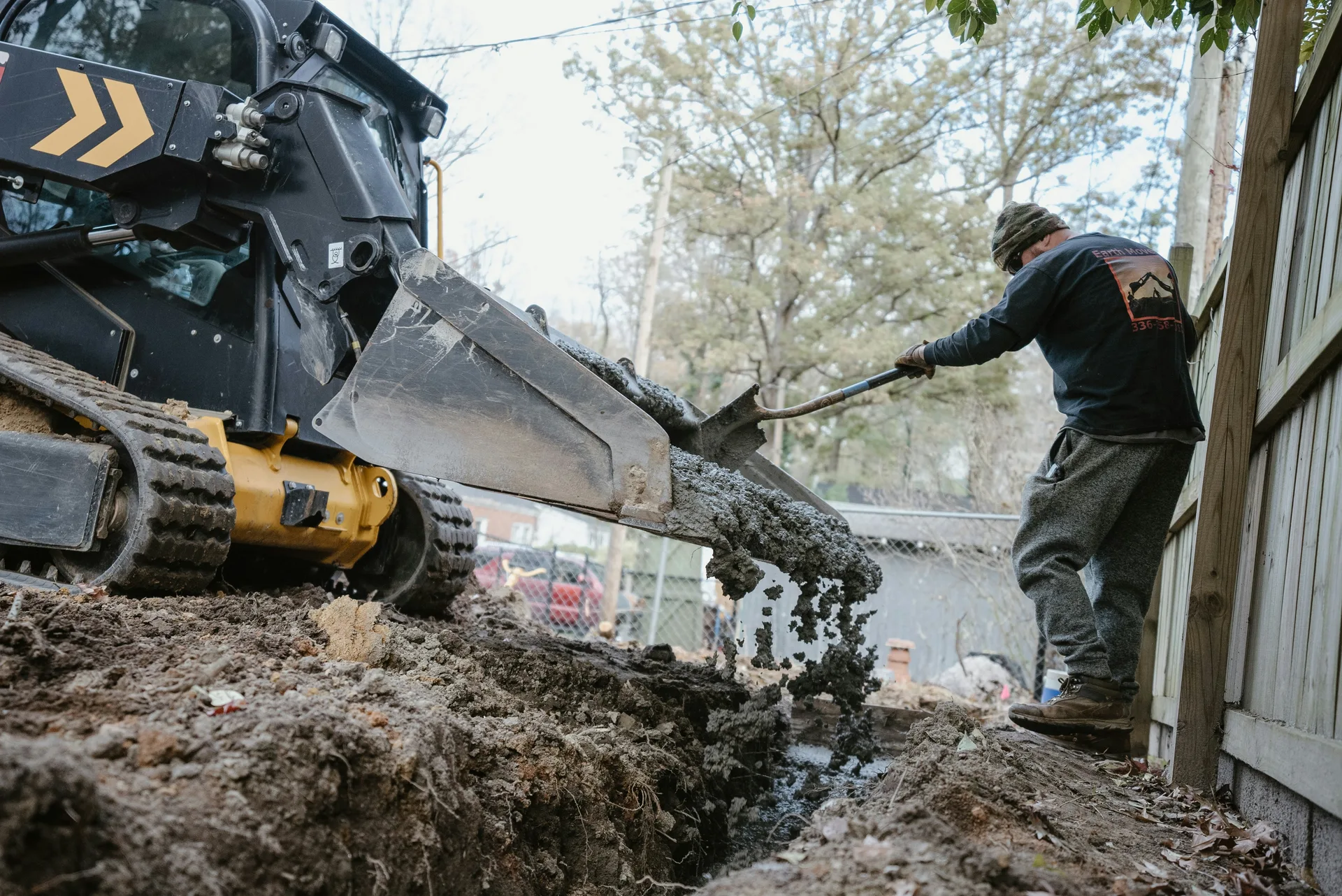
Spring Runoff Is the Hardest Test Any Driveway Faces
More water moves across and through a driveway during spring melt than at almost any other point in the year, which is exactly why washouts cluster in March and April across our service area. If you're looking at a washed-out section right now, the first thing to figure out isn't how to fix it long-term , it's whether it's urgent.
Step 1: Is Your Access Actually Blocked?
If the washout is severe enough that your driveway isn't passable , for a regular vehicle, or critically, for emergency services if something were to happen , that's the situation that warrants calling for emergency repair instead of scheduling routine work. If it's a rough but still drivable section, you have more flexibility on timing, though it's still worth addressing before it gets worse with the next heavy rain.
Step 2: Look at What's Actually Exposed
Before doing anything, take a look at what the washout exposed. A washout that's removed surface gravel but left a firm subgrade underneath is a more straightforward fix than one that's exposed soft, saturated soil or undermined the driveway at a culvert crossing. If you can see the culvert itself , exposed, shifted, or with water still actively flowing around rather than through it , that's a sign the culvert itself may be undersized or blocked, not just a surface gravel problem.
Step 3: A Temporary Fix vs. a Real One
If you need access restored quickly and the damage is limited to surface gravel, filling and compacting the washed-out section can reasonably hold until a proper repair is scheduled. This is a genuine stopgap, not a fix , if the same spot washed out this year, the underlying cause (usually a flat crown, blocked drainage, or undersized culvert) is still there, and an unaddressed cause means an unaddressed problem next spring too.
A proper repair addresses the actual cause: correcting the crown so water sheds to the sides instead of running down the driveway surface, clearing or resizing a culvert that can't handle spring flow, or regrading the whole affected section instead of just filling the hole. This is meaningfully more work than a gravel patch, but it's the difference between fixing the problem and rescheduling it for next spring.
Why This Happens: The Actual Mechanics
Spring washouts follow a predictable pattern once you understand what's happening. Snowmelt releases a large volume of water over a short period, often faster than frozen or still-thawing ground can absorb it. That water follows the path of least resistance , which, on a driveway with a flat or reversed crown, is often straight down the driveway surface itself rather than off to the ditches on either side. Moving water at volume erodes loose gravel quickly, and once it finds a weak point (an undersized culvert, a low spot, a section where the base was never properly compacted), that's where the washout concentrates.
How to Prevent the Same Washout Next Spring
The single most effective prevention is correcting whatever caused this year's washout before next spring, not just repairing the visible damage. If it's a crown problem, regrading properly restores the shape that directs water to the sides. If it's a culvert problem, resizing or clearing it addresses the actual bottleneck. If it's a recurring low spot, sometimes the fix is regrading the whole section instead of just the worst point, since a low spot that's only partially corrected often just moves the washout a few feet instead of eliminating it.
Fall is also worth a proactive check , clearing leaves and debris from ditches and culverts before winter reduces the chance of ice-blocked drainage contributing to a worse washout the following spring. See our maintenance guide for the full seasonal picture.
Serving Simcoe County & Muskoka
We handle washout repairs , both emergency and scheduled , across our full service area. If your washout is at a road entrance rather than further up your driveway, a permit may be required for culvert work; see our entrance permit guide for what applies in your township. For the full picture on driveway construction and repair, visit our driveway construction pillar.
Driveway Washout Repair — Frequently Asked Questions
Is a washed-out driveway an emergency?
It depends on whether it's currently passable and whether it's your only access to the property. A driveway with a washed-out section that's still drivable, even carefully, can usually wait for a scheduled repair. A washout that's blocked your only access entirely, especially if it affects emergency vehicle access, is worth calling about right away instead of waiting.
Why does my driveway wash out every spring at the same spot?
A recurring washout in the same location is almost always a sign of an undersized or blocked culvert, a crown that's gone flat and is directing water down the driveway instead of off to the sides, or a drainage path that was never properly established at that point. Regraveling the same spot every spring without fixing the underlying cause means you'll be back doing it again next year.
Can I just add gravel to a washed-out section myself?
For a minor washout with no significant base damage, adding and compacting fresh gravel can be a reasonable temporary fix to restore access. For a washout that's exposed or damaged the base, or one that keeps recurring, gravel alone won't address the actual cause. The crown, drainage path, or culvert sizing needs correcting, or the same spot will wash out again.
How quickly can you get to an emergency washout?
Turnaround depends on season and current schedule, but washouts blocking sole access to a property are prioritized ahead of routine scheduled work. Call us directly instead of using the online estimator if your access is currently blocked — we'll get a realistic timeline to you faster that way.
Washout Blocking Your Access? Call Us Directly
For active access-blocking washouts, call rather than wait on an online estimate , we prioritize these ahead of routine scheduling.
Get Your Free Driveway EstimateOr call us: (647) 697-7549